I found this jewel, "You may be from the West Side of Buffalo if..." while looking for something online at work. It appears to have been written when the West Side was more of an Italian neighborhood than Hispanic, as it is now. Maybe ten years ago?
Anyway, enjoy.
Tuesday, May 6, 2008

Monday, May 5, 2008
Wednesday, April 9, 2008
Studio city
Buffalo was recently named the #1 Arts Destination for Mid-Sized cities by American Style magazine. It shares the honor with big-size New York and small-size Santa Fe. I think, for the people who live here, this is a welcome but unsurprising recognition.
In their write-up (graciously passed along by my friend Melissa!), they mention Buffalo's efforts to attract and retain working artists with the subsidized Artspace Lofts housing project. While Artspace seems great--after all, I've got a soft spot for intentional communities--I'd like to see more attention placed on the easy opportunities for inexpensive work/live spaces in the City. Artists desiring studio and living space--hell, living quarters!--would likely find Buffalo's housing market a treasure trove.
In their write-up (graciously passed along by my friend Melissa!), they mention Buffalo's efforts to attract and retain working artists with the subsidized Artspace Lofts housing project. While Artspace seems great--after all, I've got a soft spot for intentional communities--I'd like to see more attention placed on the easy opportunities for inexpensive work/live spaces in the City. Artists desiring studio and living space--hell, living quarters!--would likely find Buffalo's housing market a treasure trove.
Using our house and situation as an example, here's what's to offer:
- Two homes (both doubles) with a combined 4,000 square feet (roughly 2,000 ft. each
- Rental income on the front home
- Two apartments in the back house with 2-3 bedrooms in each plus a full attic
- A mortgage payment a little over $500 a month
- Less than a mile or two from the Elmwood Village and downtown Buffalo, both of which host art galleries, theaters, shops, and other points of interest
- Walkable distance to Grant Street with its family-owned Italian market, butchers, pharmacy, community center, and more
Before Steve and Sara moved to the downstairs apartment, Steve's music studio sprawled throughout the living room. We had an enormous home "theater" in one of the extra bedrooms and a "dead daughter room," which was for all intents and purposes a guest room. The kitchen was unused. In short, we had plenty of room. Even now, there's a lot of room down there and Steve has a small, magenta-painted music studio in one of the bedrooms. I still have, as I always have since we moved in, an office in which I write and store massive amounts of junk.
So, artists, come to our city and turn a vacant house problem into progress.
Wednesday, April 2, 2008
Looking for ladies with the know how
From time to time I take a look at the Seal Press submissions page to see if any of their upcoming anthologies are a fit for me. I thought I'd highlight this current call seeing that it includes a request for female "home repair" experts (I am not one, sigh).
Want to be a Seal Author?
Here’s your chance. Seal Press is launching a new series and we’re looking for writers who are experts on the following topics:
Want to be a Seal Author?
Here’s your chance. Seal Press is launching a new series and we’re looking for writers who are experts on the following topics:
Car repair
Camping
Home repair
BBQing
We’re looking for women writers who are passionate about these topics. Whether it be your passion, your hobby, or your profession, the main qualifier is that you really know your stuff. We want writers who can translate these subjects in an intelligent, fun, and accessible style. We’ll tell you the details of the series upon seeing your qualifications.
Requirements:
One-page cover letter
detailing why you’re the person to write on this topic
Resume or CV
Previous publishing experience
Anything that you think sets you apart
from other applicants (keep this within reason, please)
Send materials in a word document attachment, in the order listed above, to Brooke Warner at: brooke.warner@avalonpub.com.
Monday, March 31, 2008
Questions about NACA: Round #2
Apologies for the delay in this next installment. I was unexpectedly out of town...
What's your experience with NACA's rehab department, HAND?
Not good--not good at all.
But before I launch into my tirade, let me give a little background: NACA members have the option of taking out rehab loans for their property at either a lesser, equal, or higher amount than the amount of their mortgage. Both loans--the mortgage and the rehab funds--get rolled into one payment. We took out a rehab loan worth a quarter of our mortgage loan. Follow me so far?
Prior to closing, buyers are required to get 2-3 estimates on each item of work they need done. This is difficult for a couple reasons: for one, it's hard to get into a house you don't yet own and for another, it's challenging to coordinate with 2-3 contractors per job. We had many jobs but luckily, we only needed to choose two separate companies to handle them all in the end. Still, a lot of groundwork.
After closing, we were told that work on the house needed to start immediately. Our contractors needed to fill out 5-8 pages of paperwork to begin their work and another 5-8 pages to complete it and receive payment. As if the paperwork itself were not enough, the HAND department is completely and utterly incompetent.
In year or so that we've been dealing with the HAND department, staff turnover has been high. Perhaps for this reason, very few staff members know what they're doing. Staffers often contradict each other or themselves, and they rarely seem familiar with NACA's own policies and procedures. You can forget about developing a relationship with someone in the department because they will either leave before you get a chance to call again or not remember you at all, despite the fact that you spoke for 15 minutes the day before.
(Can you tell I hate this part? Steve has often felt violent after hanging up with HAND; I relate.)
The very real consequences of this staffing problem come into play when it's time for contractors to get paid. In short, it takes forever. Both of our contractors have told us they will never again do a NACA job. My friend Michael, a contractor, said he will never again do a NACA job after he spent hours of his life on the phone with the idiots at HAND--and he's the one who recommended NACA to us!
So, I would not recommend getting a substantial loan for rehab from NACA. I'm glad we got ours--annoyances aside--because we would not have been able to afford the repairs out of pocket, but I am thankful that they were relatively small, done by two contractors and completed within six months of closing. I have a friend who took out upwards of $40K in rehab and her experience has been, it seems, a nightmare.
I hope to never interact with the NACA HAND department again.
I'm working with the NACA program now in Baltimore, and I want to give up. No one returns your calls or e-mails, and the turnover is so terrible you end up working with several counselors before you can close.
I've heard people in other cities, besides Baltimore, voice similar complaint about NACA offices. Just like any business, I'm sure much of the experience depends on the staff. I found Buffalo's office to be responsive, helpful, and reasonable both before and after we closed. Good for us, I guess.
When we were wrapping up with our counselor John and moving on to work more appropriate for our NACA-paid lawyer, I definitely got the sense that our progress was freeing up room for more people. John is no doubt a busy guy so I think it's even more incredible that he returns my calls.
All this being said, given my experience with the HAND department, I think NACA does need to do some top-level evaluation of its departments and regional offices. Inconsistency seems to prevail.
What's your experience with NACA's rehab department, HAND?
Not good--not good at all.
But before I launch into my tirade, let me give a little background: NACA members have the option of taking out rehab loans for their property at either a lesser, equal, or higher amount than the amount of their mortgage. Both loans--the mortgage and the rehab funds--get rolled into one payment. We took out a rehab loan worth a quarter of our mortgage loan. Follow me so far?
Prior to closing, buyers are required to get 2-3 estimates on each item of work they need done. This is difficult for a couple reasons: for one, it's hard to get into a house you don't yet own and for another, it's challenging to coordinate with 2-3 contractors per job. We had many jobs but luckily, we only needed to choose two separate companies to handle them all in the end. Still, a lot of groundwork.
After closing, we were told that work on the house needed to start immediately. Our contractors needed to fill out 5-8 pages of paperwork to begin their work and another 5-8 pages to complete it and receive payment. As if the paperwork itself were not enough, the HAND department is completely and utterly incompetent.
In year or so that we've been dealing with the HAND department, staff turnover has been high. Perhaps for this reason, very few staff members know what they're doing. Staffers often contradict each other or themselves, and they rarely seem familiar with NACA's own policies and procedures. You can forget about developing a relationship with someone in the department because they will either leave before you get a chance to call again or not remember you at all, despite the fact that you spoke for 15 minutes the day before.
(Can you tell I hate this part? Steve has often felt violent after hanging up with HAND; I relate.)
The very real consequences of this staffing problem come into play when it's time for contractors to get paid. In short, it takes forever. Both of our contractors have told us they will never again do a NACA job. My friend Michael, a contractor, said he will never again do a NACA job after he spent hours of his life on the phone with the idiots at HAND--and he's the one who recommended NACA to us!
So, I would not recommend getting a substantial loan for rehab from NACA. I'm glad we got ours--annoyances aside--because we would not have been able to afford the repairs out of pocket, but I am thankful that they were relatively small, done by two contractors and completed within six months of closing. I have a friend who took out upwards of $40K in rehab and her experience has been, it seems, a nightmare.
I hope to never interact with the NACA HAND department again.
I'm working with the NACA program now in Baltimore, and I want to give up. No one returns your calls or e-mails, and the turnover is so terrible you end up working with several counselors before you can close.
I've heard people in other cities, besides Baltimore, voice similar complaint about NACA offices. Just like any business, I'm sure much of the experience depends on the staff. I found Buffalo's office to be responsive, helpful, and reasonable both before and after we closed. Good for us, I guess.
When we were wrapping up with our counselor John and moving on to work more appropriate for our NACA-paid lawyer, I definitely got the sense that our progress was freeing up room for more people. John is no doubt a busy guy so I think it's even more incredible that he returns my calls.
All this being said, given my experience with the HAND department, I think NACA does need to do some top-level evaluation of its departments and regional offices. Inconsistency seems to prevail.
Thursday, March 20, 2008
One year as a homeowner, this friday
This Friday marks the one year anniversary of our closing, otherwise known as The Day My Hand Fell Off From Signing So Many Papers. Hurrah!
I thought I'd do a little retrospective and include never-before-seen-on-the-internet photographs of the house. The scenes and spaces may look familiar but I've a soft spot for the kind of light you get with film, especially with a well-used and known camera (click the photos for bigger versions).
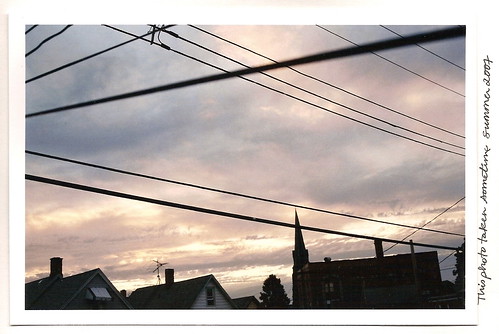
Another telephone wire and sky shot, this one taken from the kitchen window.
This year we've made the following repairs/improvements to the houses: new porch roof, new siding on the back of the house, two new furnaces, one new boiler, some chimney work, a new back door, a new drop ceiling in the rented house, multiple toilet repairs, new paint throughout both houses, electrical work, security lighting, and probably other stuff I'm forgetting.
We survived two incidents of overflowing toilets and crumbled ceilings (including one tonight!), a couple flooded basements, mice infestation, broken toilets, clogged tubs and sinks, and lengthy discussions with CitiMortgage customer service reps.
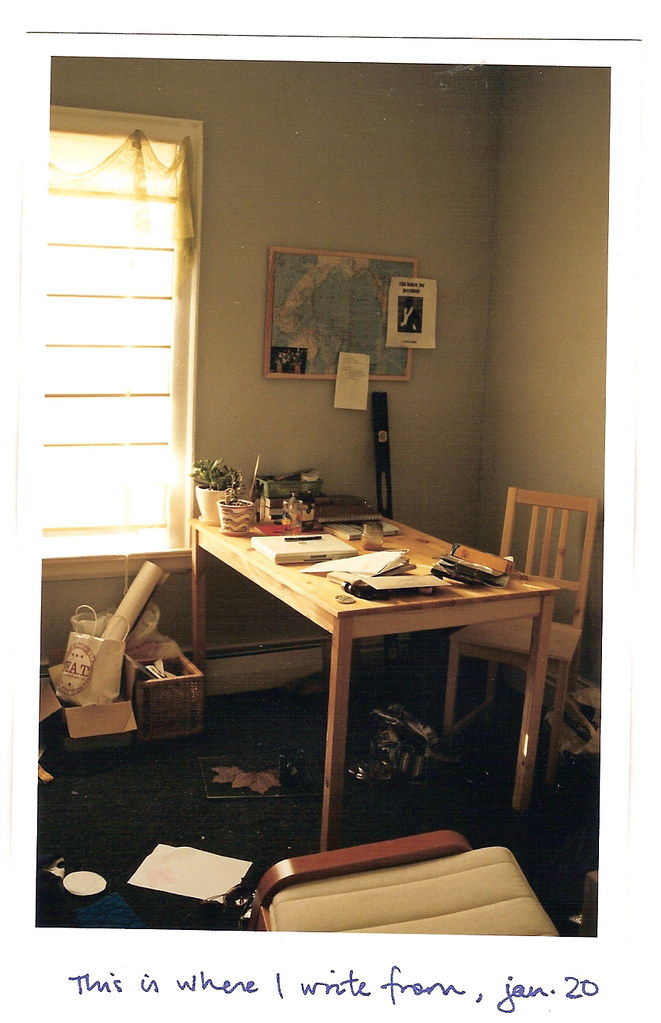
My office with nice light. Still messy, as always.
Also, I planted tulip bulbs.
Tuesday, March 18, 2008
Questions about NACA: Round #1
I've compiled the questions you've asked about NACA through the comments section of this blog, over email, and through MySpace. I will answer them in a series of posts. Some of them I grouped into general issues/concerns with the program. Please keep in mind that I'm speaking about my and Steve's experience; other NACA members may have a different take on its services, positive or negative. I'll throw in a few anecdotes from friends here and there.
How long did it take you to get through the NACA process?
Steve and I knew we wanted to buy a house in the City of Buffalo but beyond that, we were clueless. We were leaning to the West Side but were also willing to consider properties closer to the Canisius College area and Black Rock/Riverside. In our hearts, we wanted a house tomorrow but in our heads, we knew it made sense to go slow.
I think this reality affected our experience with NACA in a positive way. We didn't have a neighborhood or a house in mind--as some people who contacted me do--so it didn't matter, for example, that we had to wait three weeks after our NACA workshop for a one-on-one appointment.
From finding out about NACA and attending the required workshop to closing on our house, the process took about a year. If I remember correctly, both presenters at our workshop said their process took around a year too.
While I understand the frustration associated with slow-moving bureaucracies, I think that the process NACA puts its members through is a good thing. If the goal is to give first-time homeowners mortgages that are non-predatory in their nature, fixed at low interest rates, and genuinely affordable for that buyer, then an education process is a must. NACA members are required to create budgets, accumulate savings, take care of bad debt, and be reasonable about what they can risk. This hand-holding was great for us; some people might find it annoying.
For about 4-5 months, all Steve and I did was save money, pay bills on time, and check in every couple of weeks with our counselor John (he was very accessible). Once we had enough money saved--that magic number was determined early on--we got hooked up with a real estate agent. About two months and many homes later, we found "it" and made an offer. After that, everything moved along well.
(I can't say express enough how grateful I am for taking this process slow. It's the biggest investment I made; I'm glad I looked at 15 houses and had enough money saved to buy paint supplies after closing.)
I think the slowest part of the NACA process is accumulating enough savings and credit. For those of you hoping to speed this part up, come to your first appointment with money in the bank and a budget already created.
What's your relationship like with NACA post-closing?
This is a two part answer because there are really two relationships to consider: that with our local NACA office and counselor, and that with the NACA rehab department (known as HAND). I will get to the HAND stuff in another post--trust me, I've got a lot to say!
Regarding the local office: each member is required to participate in two NACA "actions" per year as an agreement of his/her membership. These actions aren't enforced with an iron fist and I suppose if you wanted to blow them off completely, you probably could. That would also make you an ass.
The "actions" are pretty diverse and include the following choices: office work, speaking for ten minutes at a workshop about your experience, attending an advocacy event, and putting a lawn sign on your front yard. You can also sit on a panel and review current requests for NACA's Neighborhood Stabilization Fund loans from other members. We did this last one a couple months ago and it took an hour.
Beyond the actions, I've had very few reasons to call our counselor John post-closing. I did reach out to him regarding my trouble with CitiMortgage and he had some helpful advice. I would not hesitate to call him again if needed. Around the time I was having trouble with the bank, a different NACA rep from out of town called me to check in and see if things were going ok. They frequently monitor the status of member's loans and will check in if things look hairy. Luckily, my problem was finally resolved the day before so I didn't need his help. Still though, I appreciated the call.
How long did it take you to get through the NACA process?
Steve and I knew we wanted to buy a house in the City of Buffalo but beyond that, we were clueless. We were leaning to the West Side but were also willing to consider properties closer to the Canisius College area and Black Rock/Riverside. In our hearts, we wanted a house tomorrow but in our heads, we knew it made sense to go slow.
I think this reality affected our experience with NACA in a positive way. We didn't have a neighborhood or a house in mind--as some people who contacted me do--so it didn't matter, for example, that we had to wait three weeks after our NACA workshop for a one-on-one appointment.
From finding out about NACA and attending the required workshop to closing on our house, the process took about a year. If I remember correctly, both presenters at our workshop said their process took around a year too.
While I understand the frustration associated with slow-moving bureaucracies, I think that the process NACA puts its members through is a good thing. If the goal is to give first-time homeowners mortgages that are non-predatory in their nature, fixed at low interest rates, and genuinely affordable for that buyer, then an education process is a must. NACA members are required to create budgets, accumulate savings, take care of bad debt, and be reasonable about what they can risk. This hand-holding was great for us; some people might find it annoying.
For about 4-5 months, all Steve and I did was save money, pay bills on time, and check in every couple of weeks with our counselor John (he was very accessible). Once we had enough money saved--that magic number was determined early on--we got hooked up with a real estate agent. About two months and many homes later, we found "it" and made an offer. After that, everything moved along well.
(I can't say express enough how grateful I am for taking this process slow. It's the biggest investment I made; I'm glad I looked at 15 houses and had enough money saved to buy paint supplies after closing.)
I think the slowest part of the NACA process is accumulating enough savings and credit. For those of you hoping to speed this part up, come to your first appointment with money in the bank and a budget already created.
What's your relationship like with NACA post-closing?
This is a two part answer because there are really two relationships to consider: that with our local NACA office and counselor, and that with the NACA rehab department (known as HAND). I will get to the HAND stuff in another post--trust me, I've got a lot to say!
Regarding the local office: each member is required to participate in two NACA "actions" per year as an agreement of his/her membership. These actions aren't enforced with an iron fist and I suppose if you wanted to blow them off completely, you probably could. That would also make you an ass.
The "actions" are pretty diverse and include the following choices: office work, speaking for ten minutes at a workshop about your experience, attending an advocacy event, and putting a lawn sign on your front yard. You can also sit on a panel and review current requests for NACA's Neighborhood Stabilization Fund loans from other members. We did this last one a couple months ago and it took an hour.
Beyond the actions, I've had very few reasons to call our counselor John post-closing. I did reach out to him regarding my trouble with CitiMortgage and he had some helpful advice. I would not hesitate to call him again if needed. Around the time I was having trouble with the bank, a different NACA rep from out of town called me to check in and see if things were going ok. They frequently monitor the status of member's loans and will check in if things look hairy. Luckily, my problem was finally resolved the day before so I didn't need his help. Still though, I appreciated the call.
Monday, March 17, 2008
Q&A on NACA
There have been a lot of requests for our "honest take" on NACA in the comments section of this blog. I'm going to respond to them in a post on this blog over the next couple days.
If you have any lingering questions, please post a comment to this post and I'll include it. Thanks!
If you have any lingering questions, please post a comment to this post and I'll include it. Thanks!
Friday, March 14, 2008
Color links
I meant to include these in my post but here are some links I recently found related to homes and choosing colors:
- Houseblogs.net has a great slideshow of 15 entries on colors from its member sites, some of which I'll list individually here.
- An interview by Lsaspacey of SHELTER with an owner of a colorful and beautiful house (includes pictures).
- Yvestown blog follows a woman who lives in a white-walled confectionery palace--I love it!
- This new discovery, Door Sixteen, has inspired me.
- I'm not the only one with an obsession with white walls.
Intense colors WHOA!
Stairwell of an Israeli house profiled in the New York Times this week.

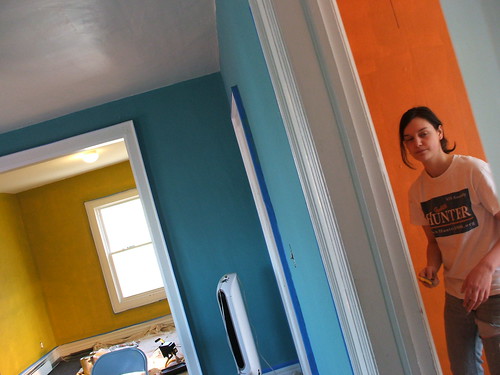
On the pro side, photographs taken in our house are always lively and engaging (I'm biased, of course) and first-time visitors to the house usually offer positive feedback. One otherwise laconic friend recently stated, "These are the colors I'd paint my house if I had the balls." Awesome, thanks!
On the con, it's a little dizzying to go from intense red to intense surfer blue in just two steps. And there's something about the bright colors that makes the space feel cluttered to me, even if it's really not. To the contrary, the two most muted (and cluttered) rooms--my bedroom and my office--are often my refuge from the intensity. They both seem to me clean, and airy.
Since Steve and Sara moved downstairs--we need an entry about that, I know--I've been contemplating future changes to the space. I'm drawn to all-white walls or at the very least some more neutral palettes. Thoughts?
Subscribe to:
Posts (Atom)